
Five Tips for Riding Southern Utah’s Best Kept Secret
Southern Utah is well known in mountain biking circles, largely due to the fame of Moab and the surrounding slickrock-studded canyon country in the southeastern corner of the state. But just bunny hop over to the south*western* corner of the state and you’ll find an amazing stash of lesser-known rides tucked away in the realm between Bryce Canyon and Zion National Parks.
This little known area features numerous world class singletrack rides long enough for full-day rides and suitable for intermediate and advanced riders. As an added bonus, much of the area is at semi-high elevation, making the prime season here June, July and August — months when it’s too hot to comfortably do a camping-based mountain bike expedition on the lower elevation trails in Moab, Gooseberry Mesa or the JEM Trails.
Here’s some beta, if you’re thinking about checking it out:
Consider a Guide
It’s well worth considering hiring a guide for any mountain bike tour between Bryce and Zion. A guide can steer you to the trails best suited to your level, provide shuttles, camping, gear, etc. Plus, the best guides are worth their weight in gold when it comes to backcountry gourmet cooking, tuning your bike each night before the next day’s ride, and giving you riding tips during the day to improve your technique.
Several outfitters offer a “Bryce to Zion” multi-day, camping-based tour, but their itineraries differ somewhat. The tour offered by [Western Spirit](https://westernspirit.com), for example, emphasizes traversing between the two national parks, much of it on dirt roads, with hikes inside the parks (you can’t ride singletrack inside the national parks, as they don’t allow them.) By contrast, [Rim Tours’](https://rimtours.com/tours/bryce-to-zion/) Bryce to Zion itinerary is 100% singletrack, with the first three days operating out of a base camp at 9000-foot Navajo Lake, just north of Zion, and the final day riding Thunder Mountain Trail immediately west of Bryce.
Thunder Mountain
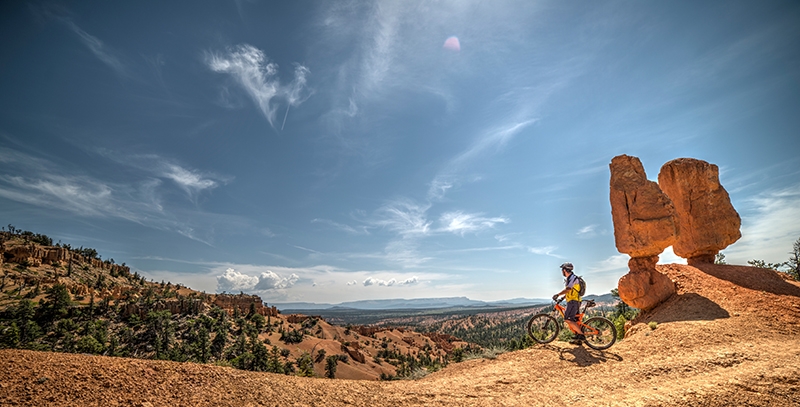
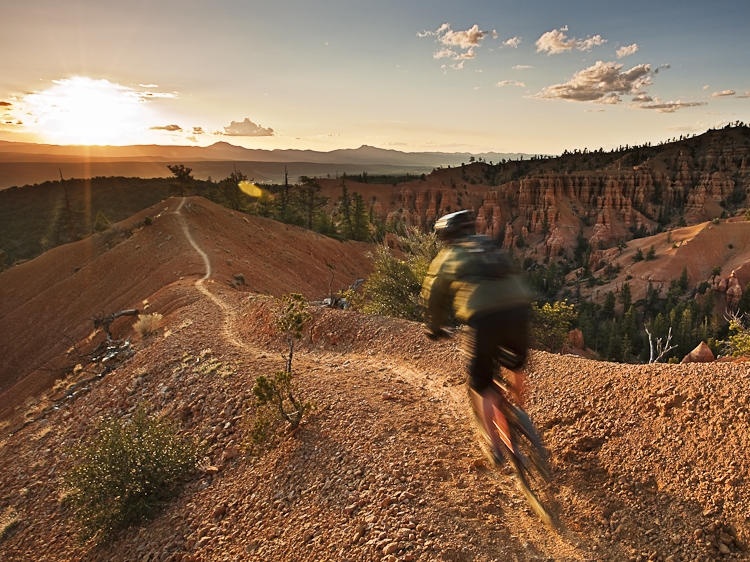
This 8-mile rollercoaster is wicked fun if you like miles of super flowy, mostly smooth hard pack with the surreal pink and orange scenic marvels of Bryce Canyon starring you in the face at every turn. Though mostly downhill from [the Thunder trailhead](https://www.mtbproject.com/trail/1868735) to the parking lot at Highway 12, there are some uphill sections that will get your heart rate up, mainly in the first third of the ride. And, though most of the trail is relatively smooth, there are a few sections of serious boulder gardens short enough to easily walk if needed, plus a mile of steep and chundery swtichbacks as you drop into the creek near the bottom. Stay off the brakes on the final mile after the creek, if you dare. Fastest ride through a forest, ever! SO fun.
You can extend your ride by parking at the bottom and riding the beautiful paved bike trail that parallels the highway, then taking the forest dirt road to the trailhead if you want to make a full day of it. And, right across the highway, the Cassidy Trail awaits, very similar to Thunder Mountain but even more aerobic and technical. It can be linked with Casto Canyon and Losee Canyon trails to create loops up to 20 miles long.
Navajo Lake
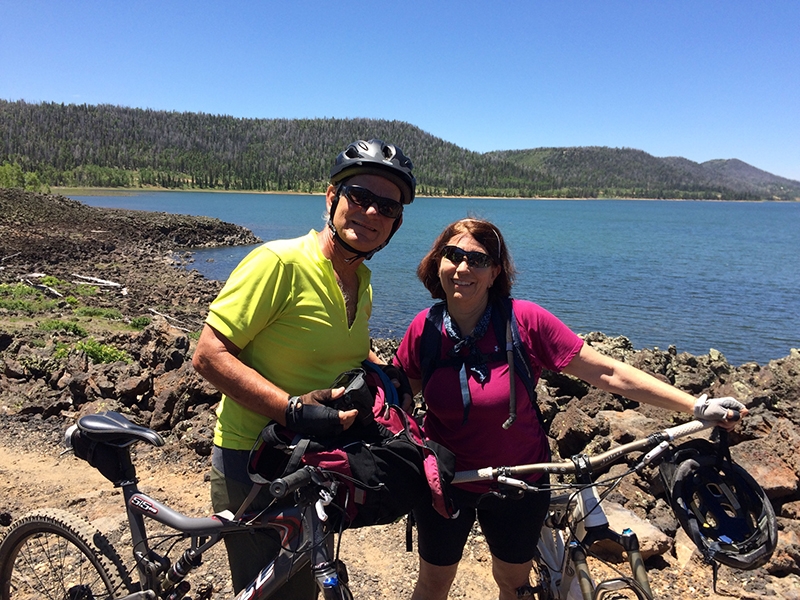This high altitude (9000 ft.) natural lake is 2 miles long and boasts several excellent USFS campgrounds making it a great base camp for exploring the region’s mtb trails. It also has a fun, flowy [singletrack loop](https://www.mtbproject.com/trail/7017197) that circles the lake for 9 miles, crossing through a dry lava bed. Perfect for a warmup ride prior to tackling the several day-long rides available on sections of the Virgin River Rim Trail directly accessible from the lake and campgrounds.
Virgin River Rim Trail
Described as “One of the best high alpine singletracks in southern Utah with great views and amazing trail,” a rider could easily spend several days exploring it fully. [MtbProject.com](https://www.mtbproject.com/trail/7018829) breaks it into 3 distinct sections, though if you are riding it from base camp at Navajo Lake, you would probably end up doing it as two rides, with one as an out-and-back (Te-Ah to Woods Ranch) and the other done one-way with a shuttle (Te-Ah to Strawberry Point.)
The ride to Woods Ranch is very “woodsy” with few of the spectacular views down into Zion NP that you get on the other sections. But the ride to Cascade Falls and beyond, to Strawberry Point, has numerous cliffside stops with views down into the norther sections of the park that will live in your mind forever. Both have some serious switchbackie sections and involve sustained climbs, so bring your extra lung, as some sections rise to almost 10,000 feet.
Bryce and Zion Parks
Even though riding within the boundaries of the parks is restricted to existing roads, since you’re in the area, you owe it to yourself to visit one or both.
In Bryce, the most popular short hike is the Peekaboo-Queens Garden Loop, and for good reason. In 5.5 miles, it gives you a sample of every different type of viewscape available in the park.
In Zion, there are so many options to choose from, it’s ridiculous – hard to single out any one thing. Probably Angles Landing, if you’re into major exposure, serious altitude gain, and crowds. Just be forewarned – due to its massive appeal and proximity to Las Vegas (2.5 hrs drive,) everything in Zion is accessible only via park shuttle bus departing from the Visitor Center (though biking is allowed on the paved road during the months that the shuttles run.)